EDA on Tweets and Data Description
Contents
- Data Resources for preliminary EDA
- Preliminary EDA
- Preliminary EDA Results
- Descpription of Final Data Used
- Generation a Clean Database
Data Resources for preliminary EDA
Data is mined and collected from the Twitter developer API (using tweepy). Twitter API passes json format data, we fetched them for two groups of users, i) 23 famous bots ii)100 famous verified real accounts. We saved the fetched tweets from both group after cleaning as a dataframe format in a csv file. We have a bit over 12,000 tweets and we plan to increase this database. For each tweet, we have 28 variables that describe some feature of the tweet.
Preliminary EDA
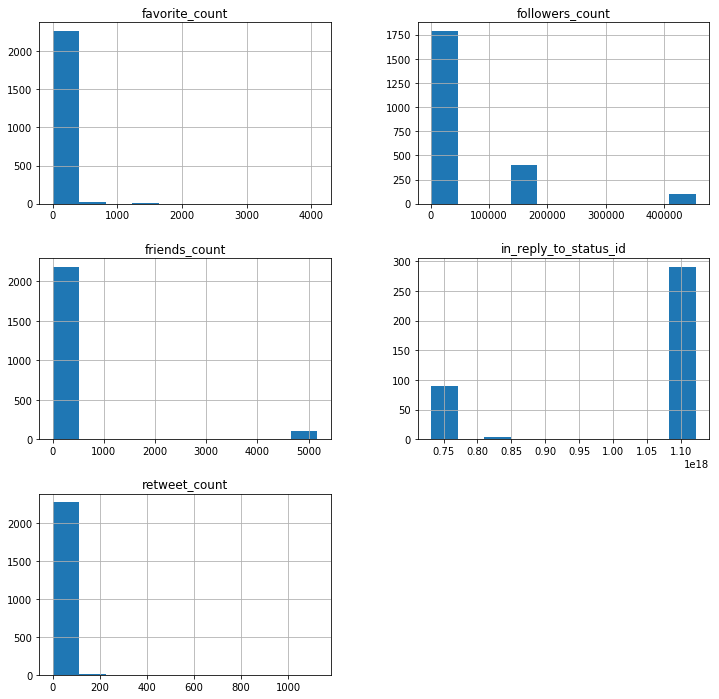
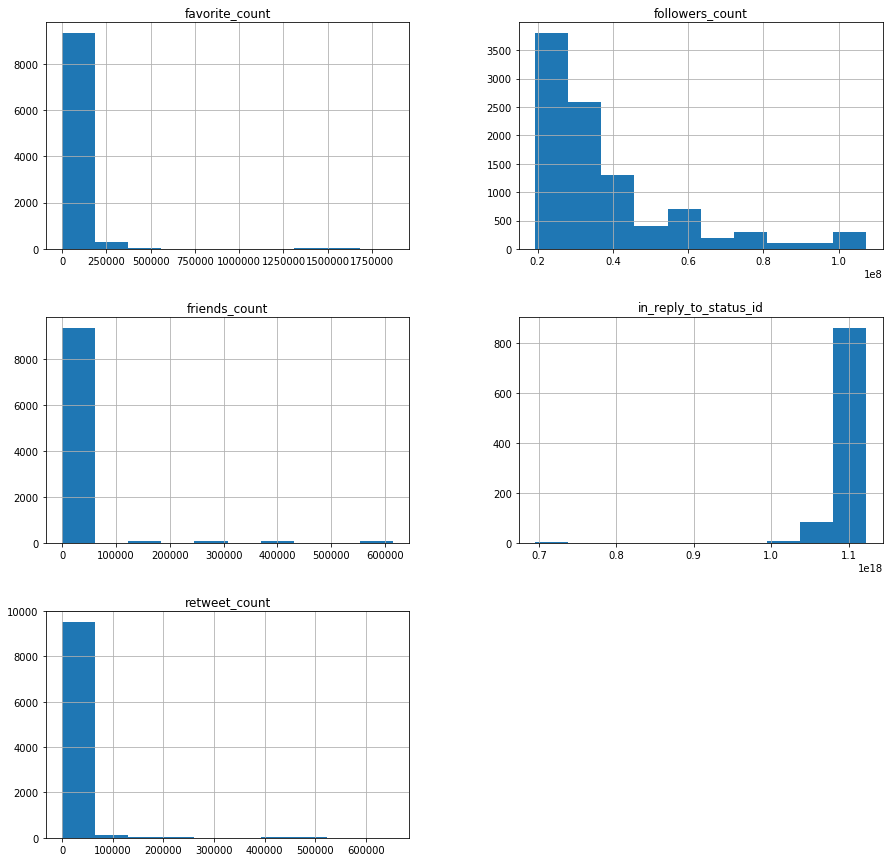
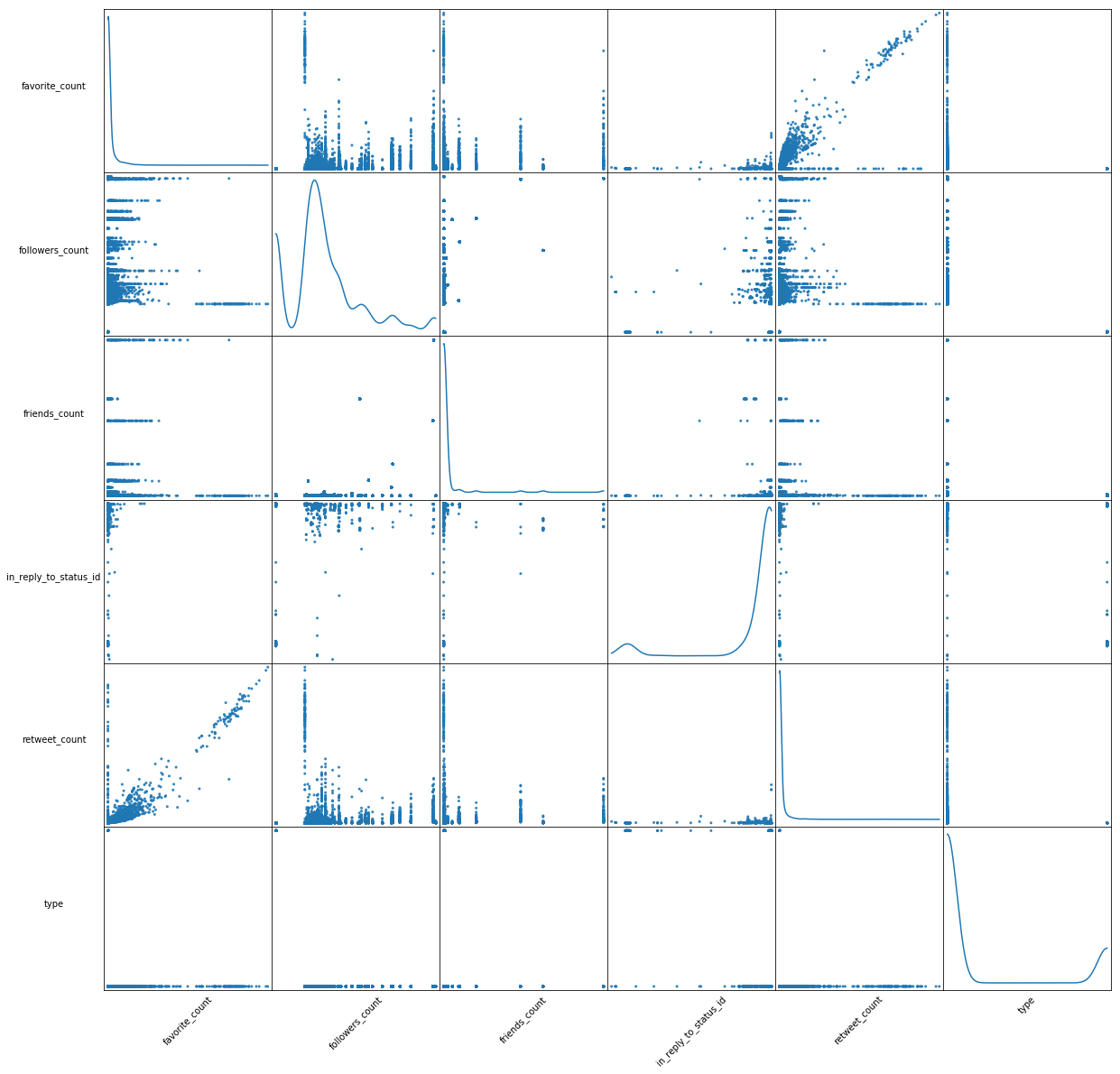
Based on preliminary EDA and histograms it seems that the following features can have predicting power:
- Followers Count
- Friends Count
- Favorites Count
- Retweet Count
As we continued to explore our data and learned more about the variables, this changed a bit. For our preliminary EDA, we used the following accounts to understand a bit about how the data is structured. This data consisted of 2,287 tweets:
count = 100
screen_names = ['@_grammar_','@attention_cnn','@NYT4thDownBot','@oliviataters','@DearAssistant','@a_quilt_bot',
                '@reverseocr', '@accidental575','@JustToSayBot','@FavThingsBot','@portmanteau_bot','@BloombrgNewsish',
                '@AwlTags',
                '@TinyCareBot','@simpscreens','@censusAmericans',' @everycolorbot','@pentametron','@AutoCharts',
                '@big_ben_clock', ' @everycolorbot','@RealHumanPraise','@wayback_exe'
               ] #,,'@pixelsorter'

tweets = fetch_tweets(screen_names,count)
Data structure was as follows:
| country_code | created_at | favorite_count | favorited | followers_count | friends_count | geo | geo_enabled | hashtags | id | ... | name | place_type | protected | retweet_count | screen_name | source | text | url | urls | verified | |
|---|---|---|---|---|---|---|---|---|---|---|---|---|---|---|---|---|---|---|---|---|---|
| 0 | AQ | Mon Jun 25 16:06:39 +0000 2012 | 2 | False | 45802 | 2 | {'type': 'Point', 'coordinates': [-89.09786011... | True | [] | 4d25f30d2fbf1463 | ... | Antarctica | country | False | 0 | _grammar_ | <a href="https://twitter.com/Your_Grammar" rel... | I declare this message by you, @sprintcare, un... | http://t.co/y2OxdNwM0Y | [{'url': 'https://t.co/YN2ntm6tBp', 'expanded_... | False |
| 1 | None | Mon Jun 25 16:06:39 +0000 2012 | 0 | False | 45802 | 2 | {'type': 'Point', 'coordinates': [-57.40262096... | True | [] | None | ... | None | None | False | 0 | _grammar_ | <a href="https://twitter.com/Your_Grammar" rel... | It was possible for you, @BoxeoMundial, to hav... | http://t.co/y2OxdNwM0Y | [] | False |
| 2 | None | Mon Jun 25 16:06:39 +0000 2012 | 4 | False | 45802 | 2 | {'type': 'Point', 'coordinates': [-59.7565709,... | True | [] | None | ... | None | None | False | 0 | _grammar_ | <a href="https://twitter.com/Your_Grammar" rel... | I insist that it would have been better if you... | http://t.co/y2OxdNwM0Y | [{'url': 'https://t.co/I4TBAoxzw3', 'expanded_... | False |
| 3 | None | Mon Jun 25 16:06:39 +0000 2012 | 1 | False | 45802 | 2 | {'type': 'Point', 'coordinates': [57.07041009,... | True | [] | None | ... | None | None | False | 0 | _grammar_ | <a href="https://twitter.com/Your_Grammar" rel... | I discovered @Bmac0507 ought to type “Marvel [... | http://t.co/y2OxdNwM0Y | [] | False |
| 4 | None | Mon Jun 25 16:06:39 +0000 2012 | 6 | False | 45802 | 2 | {'type': 'Point', 'coordinates': [27.58900536,... | True | [] | None | ... | None | None | False | 0 | _grammar_ | <a href="https://twitter.com/Your_Grammar" rel... | I consider this update by you, @EwanMacKenna, ... | http://t.co/y2OxdNwM0Y | [{'url': 'https://t.co/bEN4JKvwsa', 'expanded_... | False |
5 rows × 23 columns
Preliminary EDA Results
Bot Generated Tweets
Human Generated Tweets
Scatter Matrix
Descpription of Final Data Used
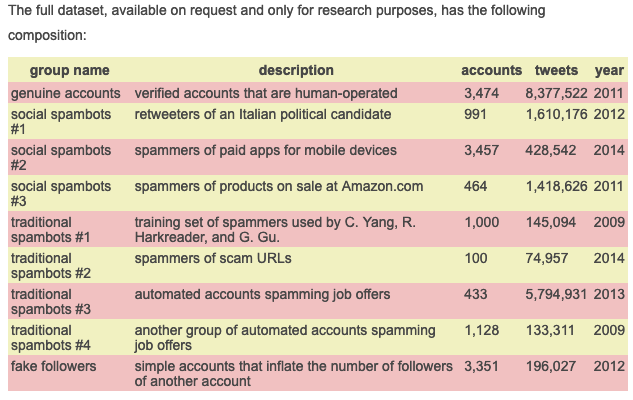
We requested permission and obtained the data from MIB researcher’s database. Detailed information on the dataset can be found here: http://mib.projects.iit.cnr.it/dataset.html. When necessary, we complemented this data using Twitters API.
The original database contained multiple levels of information for each tweet coming from a given Twitter user. Some of the data was useful, some was not. We analyzed this data and removed variables that we deemed not to be necesarry for predicting whether an acocunt is a bot. A brief description of the data obtained is described in the table below which was obtained from the MIB website linked above.
Unfortunatley, when we downloaded the data, the numbers did not match up exactly with the numbers in the table. The dataset we downloaded contained a bit over 6.6 million tweets coming from a bit over 9,700 accounts. This is still more than enough of a sample size for use to develop a model for predicting purposes.
Summary of Dataset
Generation a Clean Database
The datasets we obtained were not clean, it contained raw information. This task was very ardous as we are working with over 6 million observations and over 30 features for each datapoint. Additionally, some data needed to be turned into neural-network readable data in order for us to use it in our model.
The general purpose of this section of code is to clean the ‘twitter.csv’ files we obtained from the researchers’s dataset. These sets contained a lot of information and some missing data. We handle the missing data accordingly and clean the dataset for use in the neural network. Explanations of what we did and how we proceeded is presented throughout the code itself.
As we proceeded to clean the data, we learned new things that eventually led to the generation of new features from the data to that was used in the NN.
The data contained differing variable types for some columns which made the porcess of reading the data into a pandas dataframe difficult and slow. Here we define how some columns should be read into pandas in order to avoid warning and speed the process up a bit.
Some columns, although numerical in nature, were coerced into strings as they are more useful in that manner. For example, columns that have a user id were changed into a string instead of an integer or float as we can use this number if we need to request information from Twitter’s API.
type_dic = {'user_id': str, 'id': str, 'contributors': str,
            'crawled_at': str, 'in_reply_to_screen_name': str,
            'place': str, 'retweeted_status_id': str,
            'in_reply_to_screen_name': str, 'in_reply_to_status_id': str,
            'in_reply_to_user_id': str, 'updated': str, 'created_at': str}
We then proceeded to read in the databases and append each one into a single large database. We printed the number of datapoints read from each individual database and final count of observations.
We used error handling in order to catch any errors from reading the files or in case the files did not exit. We discovered that some files were missing from the researchers data, so we just ignore these files during the reading process.
df = pd.DataFrame()

for f in folders:
    try:
        temp_df = pd.read_csv(path+f+file_names[1], dtype=type_dic)
        if f == 'genuine_accounts/':
            real_count = len(temp_df)
        print('File {0} has shape of: {1}'.format(f+file_names[1], temp_df.shape))
        df = df.append(temp_df, ignore_index=True, sort=True)
    except FileNotFoundError:
        print('File {:s} not found, ignoring'.format(f+file_names[1]))

print('final tweet database is of shape {0}'.format(df.shape))

Output:
File genuine_accounts/tweets.csv has shape of: (2839362, 25)
File social_spambots_1/tweets.csv has shape of: (1610034, 25)
File social_spambots_2/tweets.csv has shape of: (428542, 25)
File social_spambots_3/tweets.csv has shape of: (1418557, 25)
File traditional_spambots_1/tweets.csv has shape of: (145094, 25)
File traditional_spambots_2/tweets.csv not found, ignoring
File traditional_spambots_3/tweets.csv not found, ignoring
File traditional_spambots_4/tweets.csv not found, ignoring
File fake_followers/tweets.csv has shape of: (196027, 23)
final tweet database is of shape (6637616, 25)
After reading, we added labels for bots (= 1) and real accounts (= 0) at this stage as we know this thanks to the work of the researchers. This was done linearly and quickly as we read the accounts in order of genuine accounts first and then all the bots.
bots = np.ones(len(df))
np.put(bots, list(range(real_count)), 0)
df['bots'] = bots